Overview
It is difficult to describe a ‘typical’ Berliner, simply because society is always changing and the people of the city come from a variety of backgrounds. Most of the residents have lived in the city for less than ten years and it is not easy to find a ‘born-and-bred’ Berliner. The society is quite multicultural and young, because of the universities located in the city, and the vibrant arts, dance and music scenes.
In the 1960s and 1970s, and even before, waves of immigrants from France, Turkey, Spain, Poland, Serbia and other neighbouring countries rushed into West Berlin because of the better quality life it offered. Since 1990, Russians were allowed to immigrate as well, and now the move into Berlin continues as a whole, rather than to just half of the city.
There are distinct ethnic communities in the city that you will notice on your travels. People from the same part of the world tend to cluster together. The Turkish community for example, is present mostly in the south central regions of the city such as Neukölln and Kreuzberg. There is a small amount of animosity between East Berliners (Ossies) and West Berliners (Wessies), although the comments are more or less obligatory and not too disparaging any more.
A large proportion of Berliners do not affiliate themselves with any religion, (Partly due to the fact that those that do are required to pay church tax on top of their income tax). The major religious beliefs are Roman Catholism and United evangelical Christians/Protestants. 8.8% of the population is Muslim and small pockets of Buddhists, Humanists and Jews are also seen.
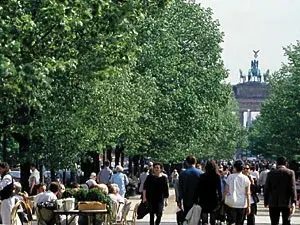
Berliners tend to be serious, reserved people with a business-like air. It is common for strangers to share your café table if the place is full. They will not offer any explanation. Accuracy and neatness are words that come to mind when describing Germans in general and definitely Berliners.
An interesting thing to know about Berliners is their penchant for nicknaming things. The Kongresshalle, for example, built as the American contribution in a 1957 architectural competition, is irreverently called the "pregnant oyster," while the new church next to the Gedächtniskirche is known as the "lipstick and powder puff," and a large global fountain in front of the Europa Center is the "wet dumpling.”