City Information
Explore city history, fast facts, climate and practical visitor information for Kuwait.
City Information
Visa Information
City Information
When to go
The winter (December to February) months are the chilliest in Kuwait, from temperatures ranging between 7°-18° C. The months of spring (February to April) offer visitors the perfect climate to explore the city, with pleasant breezy weather allowing for the desert to be blooming with exotic flowers. Even though Kuwait is not as humid as its neighboring gulf countries, the heat during summer months can prove to be extreme, going up to a high of 50°C.
Read full articleCity Information
Fast Facts
-Location: Kuwait is positioned in the northeast of the Arabian Peninsula and lies on the northwestern shore of the Gulf. It is bordered by Saudi Arabia to the south and Iraq to the north, and covers an area of 20,000 square kilometers. -Dialing code +965 -Emergency numbers Fire & Ambulance - 100 Police - 101 Red Cross - 105 Missing Children - 110 Emergency Services - 112 Directory - 1307/1234 Airport Enquiry - 24319829; -Population: 2.9 million; -Languages: Arabic and English
Read full articleCity Information
Exchange Rates
The currency used in Kuwait is the Kuwaiti Dinar (KWD).
Read full articleCity Information
Public Holidays
1 Jan New Year's Day. 25 Feb National Day. 26 Feb Liberation Day. 26 Feb Mouloud (Birth of the Prophet). 9 Jul Al-Esra Wa Al-Meraj (Ascension of the Prophet). 11 Sep Eid al-Fitr (End of Ramadan). 17 Nov Eid al-Adha (Feast of the Sacrifice). 7 Dec Islamic New Year.
Read full articleCity Information
Annual Temperature
a- January: High 13 °C Low 9 °C; ..........b- February: High 19 °C Low 12 °C; ..........c- March: High 22 °C Low 16 °C
Read full articleCity Information
Kuwait’s Residents
The population of Kuwait is estimated to be around 3-3.5 million people, including expatriates as well as locals; and about one-third of them are Kuwaiti nationals. Majority of the expatriate population comprises of Egyptians, Bangladeshis, Filipino, Pakistani and other Asian nationalities. 85% of the Kuwaiti population is made up of Muslims, and the other 15% are Christian, Hindu, Sikh, Parsi and Jewish. The urban population of Kuwait is currently at 96%, and the country hosts one of the highest literacy rates of the Arab world, that of 93%. Kuwaitis are an extremely friendly and hard-working people, who love to celebrate and welcome families and friends. Their war-stricken past has made them into one of the most patriotic and lively peoples who are very family oriented and eager to learn.
Read full articleCity Information
Kuwait today
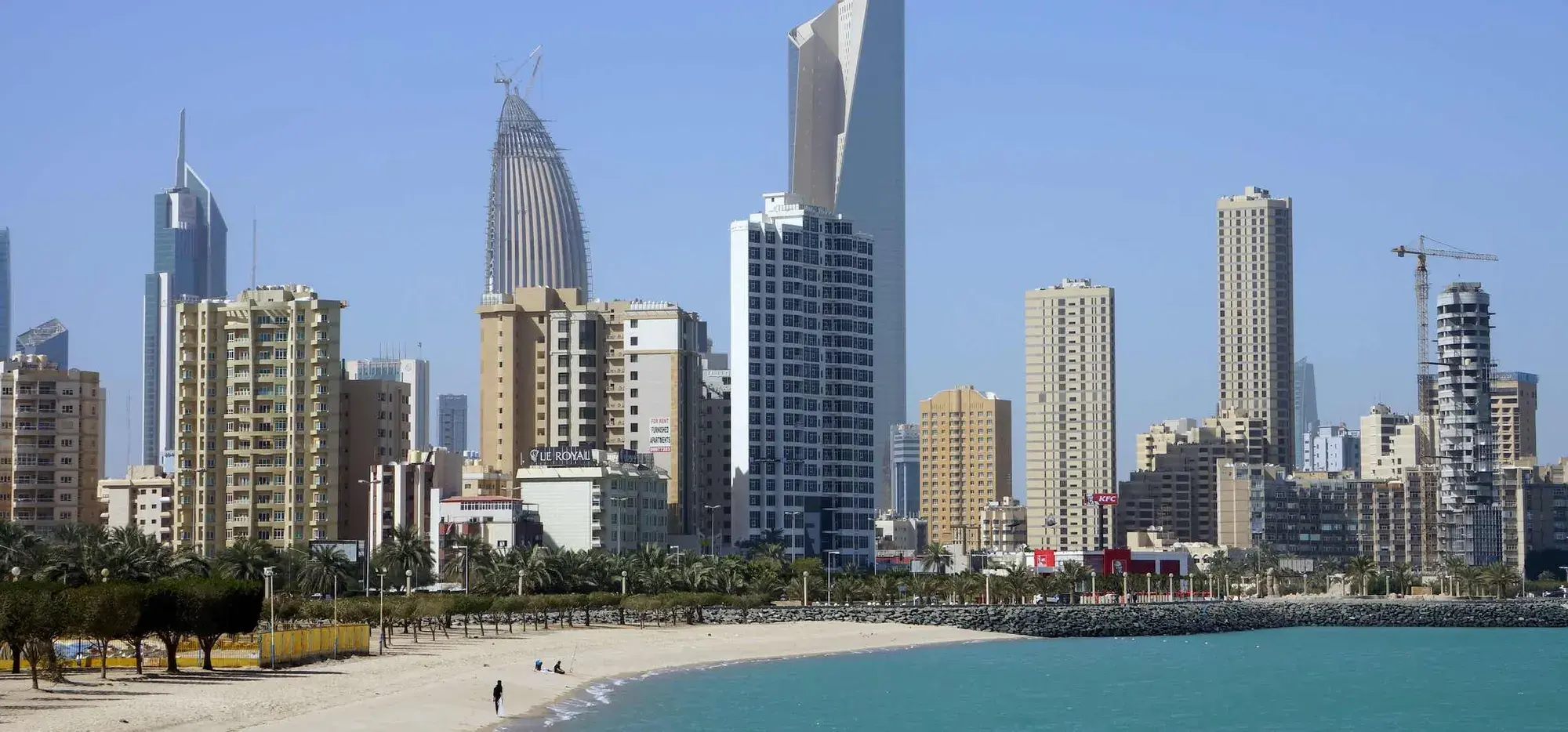
Kuwait, officially known as the State of Kuwait, small, sovereign oil-rich country, holding 10% of the worlds oil reserves. The country has the world's fifth largest oil reserves and its petroleum products constitute for nearly 95% of export revenues, and 80% of government earning. Kuwait has the utmost human development index (HDI) in the Arab world and is the eleventh richest country in the world per capita. Islamic and Arabic culture has played a strong influence on Kuwait’s architecture, clothing, music and cuisine, and most of the lifestyle revolves around tradition. Seafood has always been a staple diet of Kuwaitis and still remains popular and exotic today. The major cities of Kuwait are its Capital Kuwait City and Jahrah, while Salmiya and Hawalli remain its most densely populated residential and commercial areas.
Read full articleCity Information
Kuwait History
The name Kuwait is derived from “akwat", or "kout", in Arabic meaning ‘fortress’. The history of Kuwait can be traced back as early as the 4th century BC, with the invasion of the Greeks who colonized the land and was later taken over by tribes who came from central Arabia. The country was founded in the 1700’s when Sabah I bin Jaber was elected as the first Amir of the country in 1756. Under this rule Kuwait became a centre for trade and commerce, specializing in the pearl trade and also spices between India and Europe. With the discovery of oil in the 1930’s, the Kuwaiti government became more concerned with establishing internationally known boundaries, and Kuwait was declared an "independent sheikdom under British protectorate" under the British Army after World War I. In 1961 Kuwait became fully independent under the rule of Amir Abdullah Al-Salim Al-Sabah. The Kuwaiti Dinar was declared as its official currency. The growth of its oil and petroleum industry established Kuwait as one of the richest countries in the world. However its streak of success was soon interrupted by the Gulf War. In August 1990 Iraq troops, led by Saddam Hussein, invaded Kuwait. Kuwait was annexed and occupied by Iraq for seven months, during which the monarchy was abolished and Kuwait was declared as the 19th province of Iraq by Saddam. Kuwait was liberated in February 1991 by a multi-national military force led by the United States. Kuwait took about two years to recover from the aftermath of the war and spent over 50 billion Dollars to reconstruct and recuperate all the damages which were cause to the oil reserves and infrastructure. It has since largely recovered from the socio-economic, environmental, and public physical and mental health effects of the Gulf War.
Read full articleKeep exploring Kuwait
More places in Kuwait
Keep exploring Kuwait and add more stops to your plan.


More restaurants in Kuwait
Keep exploring Kuwait and add more stops to your plan.







More hotels in Kuwait
Keep exploring Kuwait and add more stops to your plan.