Overview & visitor information
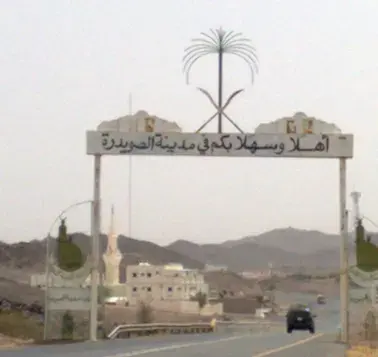
Al Suwaydirah lies 60 km northeast of Madinah on the Qassim road. It represents the remains of a deeply ancient history, with antiquities dating to seven thousand years before Christ. Wadi Al Suwaydirah presents a picture of neglect and disregard for this historic heritage, with no one protecting it, leaving it prey to neglect and defacement. As soon as you walk through the valley, you feel a sense of awe before the meticulously arranged drawings on the rocks.
Despite repeated appeals from Al Suwaydirah’s residents to officials responsible for protecting antiquities and drawing attention to them, the situation remained unchanged. Residents therefore built, through their own efforts, a rest stop overlooking the valley containing these historic drawings. Dr Abdullah bin Marzouq Al Suhaimi, head of Al Suwaydirah Centre, confirmed that the site contains important historic antiquities, prompting a group of residents to establish a tourism project in the valley serving visitors light snacks and drinks. They called on the Supreme Commission for Tourism to adopt a project preserving this heritage and turning it into a tourist resort contributing to Al Suwaydirah’s development.
Antiquities from thousands of years ago
Dr Saad bin Abdulaziz Al Rashid, former Deputy Minister of Education for Antiquities and Museums, likewise confirmed this. He said thousands of passers-by might see Al Suwaydirah as merely a remote village tucked among rocks, but the reality is different: it contains antiquities thousands of years old. He explained that Al Suwaydirah was named after an old well that still survives.
Al Suwaydirah’s location also corresponds to Al Tarf, a stop on a pilgrimage route branching from the Kufa–Makkah road known as Darb Zubaydah. The predominantly Islamic antiquities indicate that it was a settlement on the pilgrimage road from Iraq to Makkah and Madinah. Internal routes towards Madinah and the rest of central Arabia also passed through Al Tarf, today’s Al Suwaydirah.
Written inscriptions
Al Rashid believes Al Suwaydirah’s archaeological importance arises from the written records carved on the faces of rock masses, as well as rock drawings and pre-Islamic inscriptions.
Old ruins
The ruins of old Al Suwaydirah, Al Tarf, can be seen from the southeast. They are small rooms built of igneous stones in straight rows, alongside other rubble with collapsed walls.
Despite Al Suwaydirah’s development over past years, the modest agricultural area in the valley, the construction of various facilities and the damage to many written records on the valley banks and plateau through scraping and removal, the surviving inscriptions show the greatness of Islamic history and civilization and the older pre-Islamic cultural heritage.
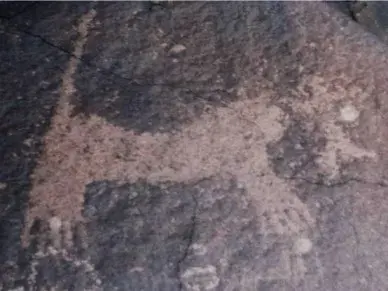
The rock drawings depict human and animal figures dating to approximately "7000.6000 BC". Large pictures of lions appear on rock masses, alongside ibex, birds, ostriches, camels, horses, mules, goats and dogs.
Some of these rock drawings date to the Stone Age, in the period "1500–2000 BC".
Inscriptions indicate that Al Suwaydirah attracted human activity because of its natural setting, plentiful water and vegetation, and position on a trade route.
Islamic-era remains consist of written records on rocks, numerous enough to confirm this place’s importance for residents and passing pilgrims, traders and herders. They rested in Wadi Al Suwaydirah under its thick trees, in the shade of rocks and caves, near farms and beside watercourses and channels whose remains and traces can still be seen today.
Most written records discovered in Al Suwaydirah are clearly written and beautiful in meaning. Their style reveals their authors’ faith in God Almighty and knowledge of His Book, the Holy Quran, and the Sunnah of His Messenger, peace and blessings be upon him. They contain traditional supplications seeking repentance, forgiveness and mercy, and affirming testimony to God alone. Most Islamic inscriptions are undated and their letters lack dots, although some bear month and year dates. Dated inscriptions in Al Suwaydirah range from 101 AH to 249 AH.
One beautiful inscription reads: "O God, forgive Abd Al Hamid bin Salim with a forgiveness that leaves none of his sin, and whoever reads this writing and whoever enters this farm as a Muslim.. Amen."
This inscription dates to the end of the first and beginning of the second Hijri centuries. Its author, Abd Al Hamid bin Salim, whose name recurs in many inscriptions in Al Suwaydirah, appears to have held standing, a presence and property, as evidenced by the farm mentioned in the inscription.