City Information
Explore city history, fast facts, climate and practical visitor information for Makkah.
City Information
Visa Information
City Information
When to go
If going for Hajj pilgrimage, check the Lunar calendar. For Umra, the best times are during the holy month of Ramadan and during the winter. During Ramadan there are huge crowds, particularly during the last ten days of Ramadan but the atmosphere is overwhelming.
Read full articleCity Information
Fast Facts
-Location: Middle East -Dialling code: +966 -Emergency numbers:
Read full articleCity Information
Saudi Arabia's currency
Saudi Riyal (SAR.) and Halalas (Hls.), with 100 Halalas equalling a Riyal
Read full articleCity Information
Annual Temperature
..........a- January; Max: 30.2 °C: Min: 16 °C ..........b- February; Max: 31.9 °C: Min: 17 °C ..........c- March
Read full articleCity Information
Makkah Residents
The people are a mix of Arabs and South Asians. People from Pakistan, India, Bangladesh, Indonesia, Malaysia and the Philippines can be found in great abundance. The most common nationality you probably will be in everyday contact with will be the Bengalis and then the Arabs. Arabs hold on to key supervisor positions while the immigrants comprise the worker force of the city.
Read full articleCity Information
Makkah today
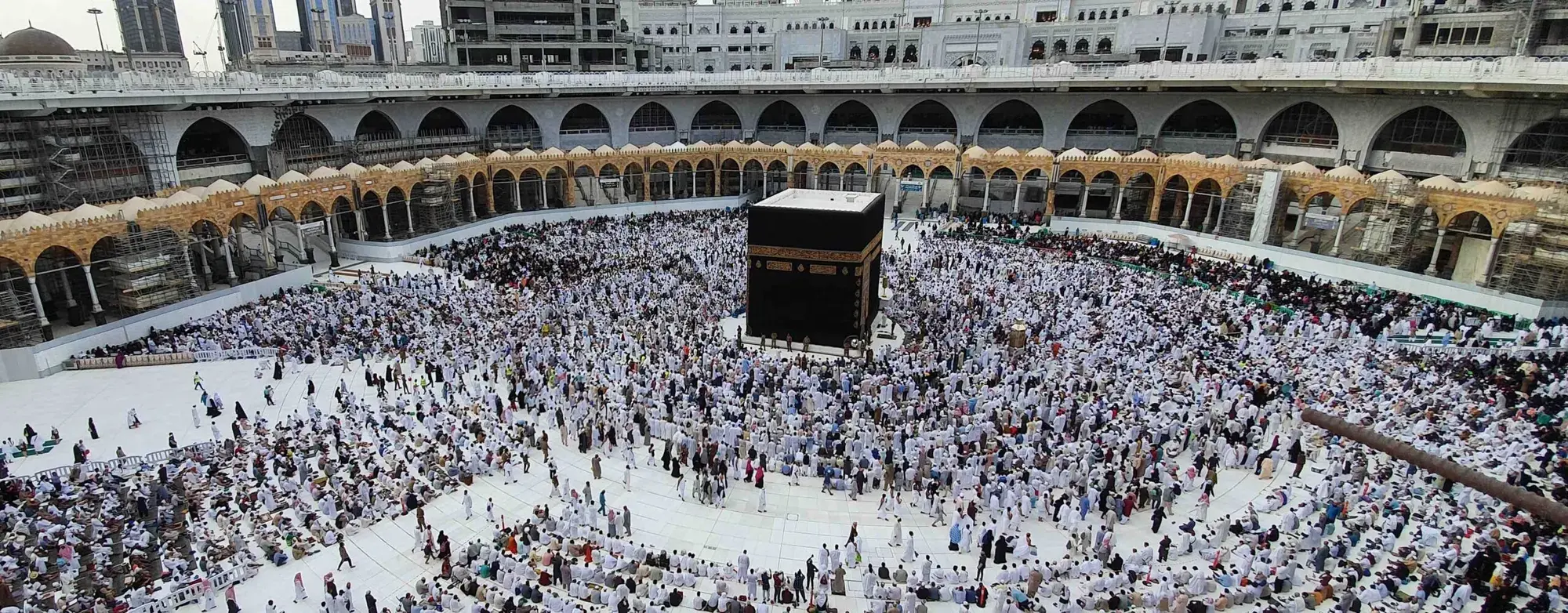
One of the oldest cities in the region and home to the most holy of all Muslim sites (Christian and Jewish too for some), Makkah receives over 3.5 million people alone during the Hajj season, and well over 15 million people throughout the year. This clearly keeps up with English definition for “Mecca” meaning: A place that attracts many visitors. The city is in the middle of a desert so summer temperatures can often soar into the fifties. Winter temperatures drop to 15 degree Celsius.
Read full articleCity Information
Makkah History
The history of Makkah dates all the way to the time of Prophet Abraham, when he left the suckling Ishmael along with his mother, Hajra under a tree on the hillock. Years later, Abraham returned and, on God’s orders, built the Ka'aba. The city steadily grew into an important trading city in the region, largely because of the holy spring of Zam Zam offering water to thirsty travellers in passing caravans. In 560 AD Prophet Muhammad (SAW) was born to one of the powerful tribes inhabiting the city. In 600 AD, Islam was revealed at the Jabal-e-Noor (Cave of Hira) to Muhammad (SAW). Consequently, the powerful pagan tribes in Makkah cast Muhammad (SAW) out in 622 AD, only to see him return eight years later with such a might that Muhammad (SAW) gained victory without having to face any resistance whatsoever. Over the centuries the Arabs kept control over the land despite the seat of power of the Muslim world shifting, first to Damascus then to Baghdad and then to Constantinople (Istanbul, Turkey) during the Ottoman Empire. A fort was built around Ka'aba to protect it. However, following the defeat of the Muslims after World War I, and the subsequent end of Khilafat Mecca was handed over to the new Arab rulers, the Saud family with certain conditions and pledges evoked from the new rulers regarding the destruction of holy sites.
Read full articleKeep exploring Makkah
More places in Makkah
Keep exploring Makkah and add more stops to your plan.
More restaurants in Makkah
Keep exploring Makkah and add more stops to your plan.




More hotels in Makkah
Keep exploring Makkah and add more stops to your plan.