Overview & visitor information
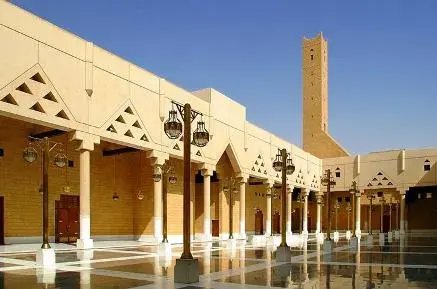
It was built on land called Al Naq’ah in central Riyadh, where Imam Turki bin Abdullah, may God have mercy on him, ordered a congregational mosque later named after him and appointed Sheikh Abd Al Rahman bin Hassan Al Al Sheikh to it. Its proximity to several neighbourhoods and Qasr Al Hukm was considered, and it was made an institution of learning in the manner of the First Saudi State. When Imam Turki prayed Friday prayers in the Grand Mosque, he customarily left through the door south of the mihrab. This door on the mosque’s qibla side was prepared for his entry and exit, avoiding the need for the imam to step over people in the many rows. These additions took place during his rule, before and through 1241 to 1249 AH (1826–1834). His son Imam Faisal bin Turki followed in 1259 AH, rebuilding the mosque and expanding it to the east and west. He introduced Islamic ornamentation into its courtyards that was then unknown in Najd, and installed an elevated passage between the mosque and Qasr Al Hukm. New water facilities were also added, and a long covered passage supported on columns connected the mosque to the palace. The traveller Palgrave described it as a large, flat-roofed parallelogram on square wooden pillars, accommodating more than two thousand worshippers at once, largely comprising an external courtyard with room for more than two thousand as well. It had no ornamentation or other aesthetic features, and had a short minaret on the roof directly above the mihrab. King Abdulaziz took an interest in the mosque, expanded it and linked it to Qasr Al Hukm by a bridge facilitating access at prayer times, especially Friday prayers, for the king, his entourage and his servants. He also installed lighting. King Saud continued to care for the mosque, enlarging its structure, ordering new carpets and lighting and greatly increasing its area by incorporating adjoining land. During those earlier royal periods, it was built with traditional materials of mud and dried mud bricks, with roofs of palm trunks and stone slabs. Care for the mosque continued under Kings Faisal and Khalid through modern construction.