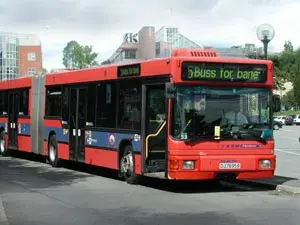
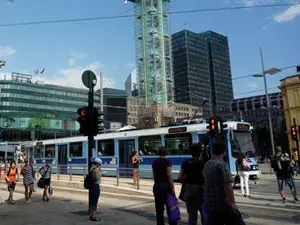
From 5am to 1am the bus and tram network around Oslo is in operation. Tickets purchased on trams and buses can be used interchangeably. Tram lines run every 10 minutes in the morning, and every 20 minutes at night. The main tram station is in Jernbanetorget, which is where the main bus and train lines can also be found. Buses cover weekend nights and none of the day passes are valid at this time. Travelling weekend nights are therefore an expensive affair, costing 50NOK per ticket or more.
The metro, in Norwegian is the Tunnelbane or just T-bane. Oslo has 6 main lines, one of which (Ringen) is the ring or loop line, which circles from northern Oslo to the centre and back. All stations except three on Ringen (Sinsen, Storo and Nydalen) have separate entrances and platforms for trains going east or west. Be sure to check the platform number to avoid unnecessary delays.
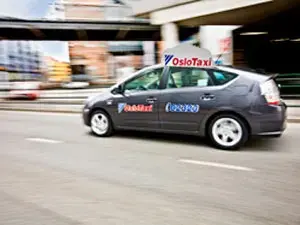
Taxis are mad expensive. Minimum charges of 80 NOK apply and at night times this can double to 160 NOK. Short trips can cost an outrageous 100 NOK so using other modes of transport (trains, buses) is a better choice. Taxis are usually spacious Volvo’s or Mercedes. To avoid being outrageously ripped off, use either Oslo Taxi or NorgesTaxi as these are the more reliable companies. Either way, however, prepare to be ripped off. All taxi companies have a starting fee (which can sometimes range from 0-160 NOK) and a fee per km. Rates vary by time of day. The lowest rate is the day rate, from 6:00am -6:00pm. The next is the evening and night rate from 6:00pm to 6:00am and the last is on Saturday’s after 18.00 till Monday 06.00, but different companies do have different time frames. All taxis accept Visa and MasterCard.
Hiring a car in Oslo is probably unnecessary since the city is fairly small and the public transportation system is excellent. Renting a car can also be very expensive, and gas prices in Oslo are notably higher than they are in North America and even many parts of Europe. Parking is also a nightmare in Oslo--meters expire after thirty to sixty minutes and the police impose large fines for illegal parking or overstaying your meter (starting at 500 NOK).
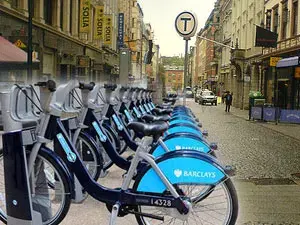
Another way to navigate Oslo is to rent a bicycle, which is very easy. The Oslo Citybike service (+47 22 02 34 88) leases bikes for three hour periods at multiple stations throughout the city. By checking in every three hours, you can functionally rent a bike for the entire day. To use the service, you must purchase an access card for 70 NOK (these can be found at the tourist office) and make a 500 NOK refundable deposit. Make sure to return or exchange your bike after three hours, or you will lose your deposit. Also, be sure to pick up a map of the bike racks in the city; bike racks are often full, so knowledge of alternative options is crucial.

There are three conventional ways to get from the Oslo airport to the city center. The high speed airport express train, Flytoget, is by far the easiest method and takes under twenty minutes to reach the city. Trains depart every ten minutes with a standard cost of 200 NOK that can be reduced based on mode of payment and age.
Driving in Oslo is fairly straightforward, although it is generally preferable to use the public transportation system. While traffic in Oslo is common (especially during rush hours from 0700-0900 and 1500-1800), the city tends to be less congested than most European cities. Navigating Oslo can be difficult for the first-time traveler because of the city’s complicated system of one-way streets.